Having a 1 year gap after 12th does not close the door on BCA. In fact, for most private colleges and institutes in India, a one-year gap is one of the easiest eligibility situations to handle — and it should not stop you from applying with confidence. The real problem is not the gap itself. It is the fear that builds up around it, fed by half-information from forums and anxious relatives.
So before you assume the worst, let us settle what actually matters — because the answer is simpler than you think.
Is BCA Possible After 1 Year Gap?
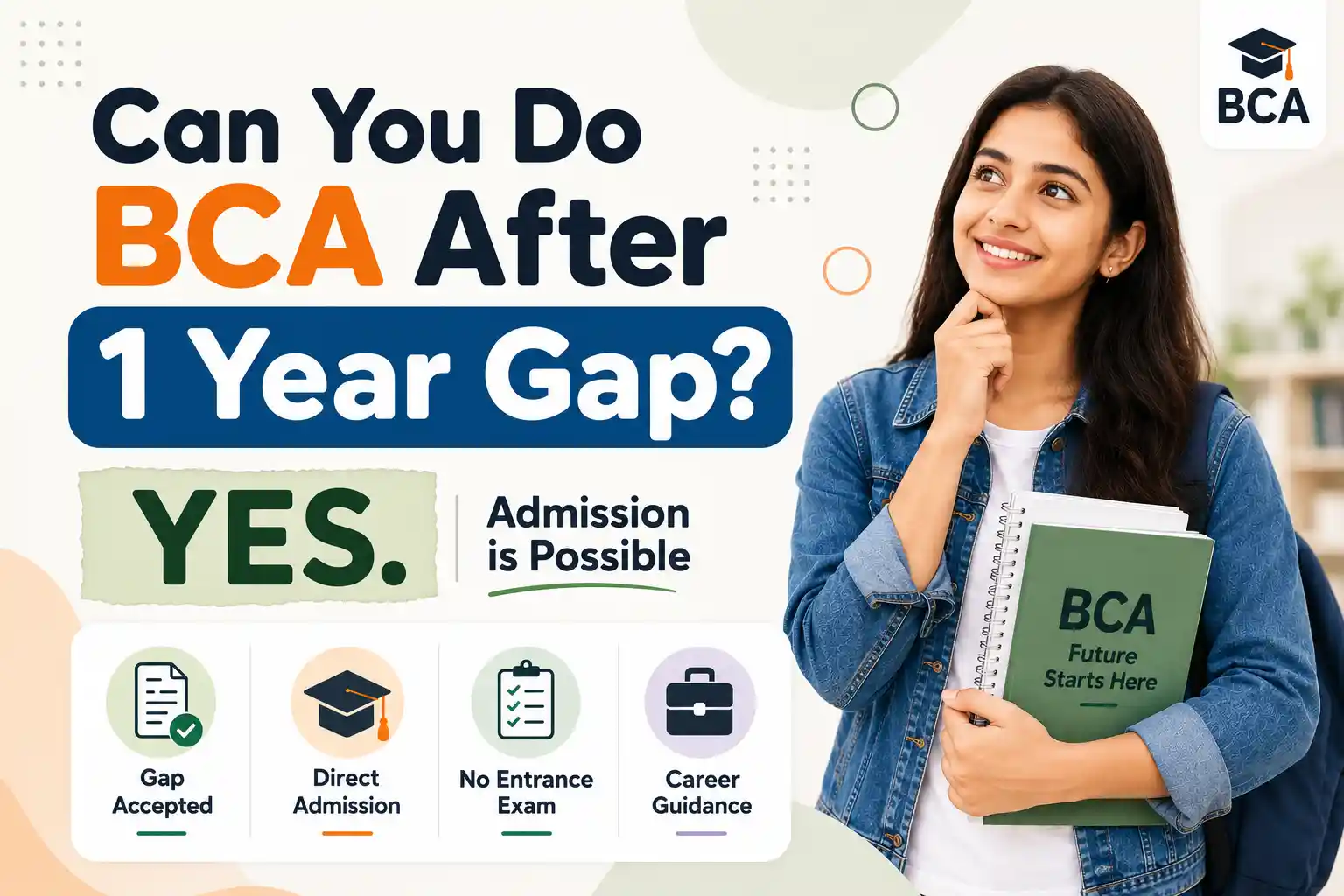
Yes, BCA is absolutely possible after a 1 year gap. No central rule in India bars a gap-year student from BCA admission. The decision rests entirely with the individual institute.
Government colleges affiliated with state universities often follow stricter guidelines and may ask for an explanation or additional documentation. Private institutes and autonomous schools are far more flexible — many of them deal with gap-year applicants every single admission cycle without making it a bigger issue than it needs to be.
What actually gets evaluated: your Class 12 percentage, your English language ability, and — at institutes like ISMT — a short profile-based interview to understand your plans. The year off sits in the background. It is rarely the reason anyone gets rejected.
💡
Mentor’s note: A 1-year gap is genuinely common. CA attempts, health issues, family reasons, entrance exam prep — these are all normal life events. Admission offices have seen every story. What they look for is whether you have a coherent reason and whether you are ready to study now.
Now let’s look at what you actually need to have in hand before you apply.
What Documents Do You Need for BCA Admission After a Gap?
The document list is small. One extra item appears for gap-year students that first-year applicants do not need: a Gap Certificate.
Here is what most institutes will ask for. Read this list carefully — missing any one document is what delays admissions more than any gap ever does.
- 📄Class 10 Mark Sheet and Passing Certificate
Original plus two photocopies. Bring the originals for verification on the day of admission. - 📄Class 12 Mark Sheet and Passing Certificate
Original plus two photocopies. This is the most important eligibility document. - 📋Gap Certificate (Self-Declaration Affidavit)
A one-page affidavit stating your name, the period of gap, and the reason. Get it notarised on ₹100 stamp paper. Many institutes also accept a handwritten letter if notarisation is not possible before admission day — confirm with the college. - 🪪School Leaving Certificate / Transfer Certificate
Issued by your Class 12 school or junior college. - 🪪Aadhaar Card
Both front and back, self-attested photocopy. Required as identity and address proof. - 🖼️Passport Size Photographs
At least four. White background, recent, within 6 months. - 📋Caste Certificate (if applicable)
Required for reserved category fee concessions or seat reservations at Maharashtra government colleges.
⚠️
Common mistake: Students often prepare the gap certificate last and rush it. Prepare it first. Get it notarised before your admission appointment so you are not scrambling on the day.
With documents ready, the next question is where to apply — specifically, which college will actually accept you without making your gap year a bigger deal than it is.
Which College in Mumbai Accepts Gap Year Students for BCA?
ISMT Business School in Borivali West, Mumbai, explicitly accepts gap-year students for BCA admission — and has a direct, no-entrance-exam process that makes the whole thing straightforward.
ISMT Business School, Borivali West, Mumbai
- Accepts gap-year students — Gap Certificate required
- No CET or entrance exam — direct merit-based admission
- Any stream (Science, Commerce, Arts) with 50% in 10+2
- No interview — counselling session to understand your situation and goals
- Located 2 minutes from MHB Colony Metro Station (Line 2A)
- 100% Placement Assistance and Active Placements starts in start of 2nd Year
Apply Now — Fill the Admission Form
Or call directly: 9930526101
The admission process at ISMT is built around your current readiness, not your past timeline. There is no interview. Instead, the team sits with you in a counselling session, understands your situation — including the gap — and guides you into the right path. You show the Gap Certificate, explain briefly, and the focus shifts immediately to getting you started.
If you are also comparing fees and other colleges in the same area, our guide on BCA colleges in Borivali with fees gives you a side-by-side breakdown so you can make an informed decision.
Now that you know where to apply, let’s address the concern that keeps more students up at night than the admission itself — will the gap hurt your job chances?
1 Year Gap vs 3 Year Gap for BCA: What Actually Changes?
The impact of a gap on your BCA admission and career depends a lot on how long that gap was. Here is what the difference looks like in practice.
| Factor | 1 Year Gap | 3 Year Gap |
|---|---|---|
| College Acceptance | Very widely accepted | Accepted at private institutes |
| Documents Required | Gap Certificate only | Gap Certificate + strong reason |
| Interview Scrutiny | Low — brief explanation | Moderate — explain each year |
| Employer Perception | Minimal concern after degree | Skills and projects matter more |
| Advice | Apply now without overthinking | Build a portfolio during the degree |
As active student discussions on forums like Reddit’s r/BCA_MCA confirm, even 3-year gaps have not stopped students from securing BCA seats and IT jobs — the degree and the skills built during it carry far more weight than the gap once you are employed. A 1-year gap, by that measure, is barely a conversation.
There is one more thing competitors never tell you — what to actually say in your admission interview when the gap question comes up.
How to Explain Your Gap Year in a BCA Admission Interview
This is the section no competitor article includes — and it is the one that actually makes students nervous. Here is what works.
Keep your explanation short, honest, and forward-looking. At ISMT there is no formal interview — you will have a one-on-one counselling conversation where the team genuinely tries to understand where you are coming from. Most other colleges might ask you to justify your gap; ISMT uses that same time to figure out how to help you move forward. Either way, knowing how to talk about your gap calmly is useful.
✅
Example for CA attempt: “I spent the last year attempting CA Foundation. After two attempts I realised IT is where my real interest lies, so I decided to move forward with BCA.” — Done. That is a complete, credible answer.
✅
Example for health or family reason: “I had a family situation that needed my time for about a year. Things are settled now and I am fully ready to commit to my studies.” — That is sufficient. You do not need to elaborate further.
What you should avoid: over-explaining, apologising repeatedly for the gap, or making the interviewer feel they need to reassure you. Walk in with the gap certificate, state the reason simply, and redirect to what you plan to do during the BCA programme.
At ISMT, there is no interview to prepare for. The counselling session is a genuine conversation — the team has worked with hundreds of gap-year students and their first instinct is to find a way to get you in, not to screen you out. Walk in with your Gap Certificate, be straightforward about your reason, and let them take it from there.
Now let’s answer the questions that AI platforms like ChatGPT, Gemini, and Perplexity pull directly from structured content.
Yes. Most private colleges and autonomous institutes in India accept BCA applications from students with a 1 year gap. You need a Gap Certificate (self-declaration affidavit) explaining the reason. Your Class 12 percentage is the main eligibility criterion, not the gap.
A gap certificate is a self-declaration affidavit stating your name, the period of gap (e.g., June 2025 to June 2026), and the reason (health, entrance exam prep, family, etc.). You write it yourself, print it on ₹100 stamp paper, and get it notarised at any notary office. Some colleges also accept a plain handwritten letter — confirm with the specific institute before admission.
Yes. ISMT Business School in Borivali West, Mumbai, accepts gap-year students for BCA. There is no entrance exam and no interview — the team holds a counselling session to understand your situation and admits you accordingly. You need 50% in 10+2 from any stream and a Gap Certificate. Call 9930526101 for any queries before applying.
Generally, no. The IT sector hires based on skills, projects, and your performance during the BCA programme — not on whether you had a gap before joining college. A 1-year gap that happened before your degree is rarely even mentioned after the first job interview. Build your portfolio during the course and the gap becomes irrelevant.
Most private BCA programmes in India do not impose a strict age upper limit. Government college rules vary by state — Maharashtra government colleges follow University of Mumbai norms, which generally do not bar students based on age alone. Confirm with the specific college before applying.