After your 12th, you want to travel and get a nice job. People claim there is growing demand in aviation. Sadly, they don’t tell you about the path or costs.
after 12th, there are four types of aviation courses. Diplomas in cabin crew or ground staff take 3-12 months and anyone can apply. These courses provide entry level airport or airline jobs. A 3 year degree in aviation and hospitality from ISMT Business School is also open to everyone and provides a management degree. The least expensive option is a Commercial Pilot License which requires 12th level with both Maths and Physics along with 18-36 months of study. Maintenance Engineering of Aircrafts is more technical and regulated by DGCA and is for the science stream. Select the course based on your economics, your stream, and if you are looking for a job in 6 months or a career in 3 years.
What Are the Actual Options After 12th?
“Aviation course” isn’t one thing. It’s four different routes, and mixing them up wastes a year.
Any stream accepted. Fastest route to a first job. Caps at entry-level unless you add more qualification later.
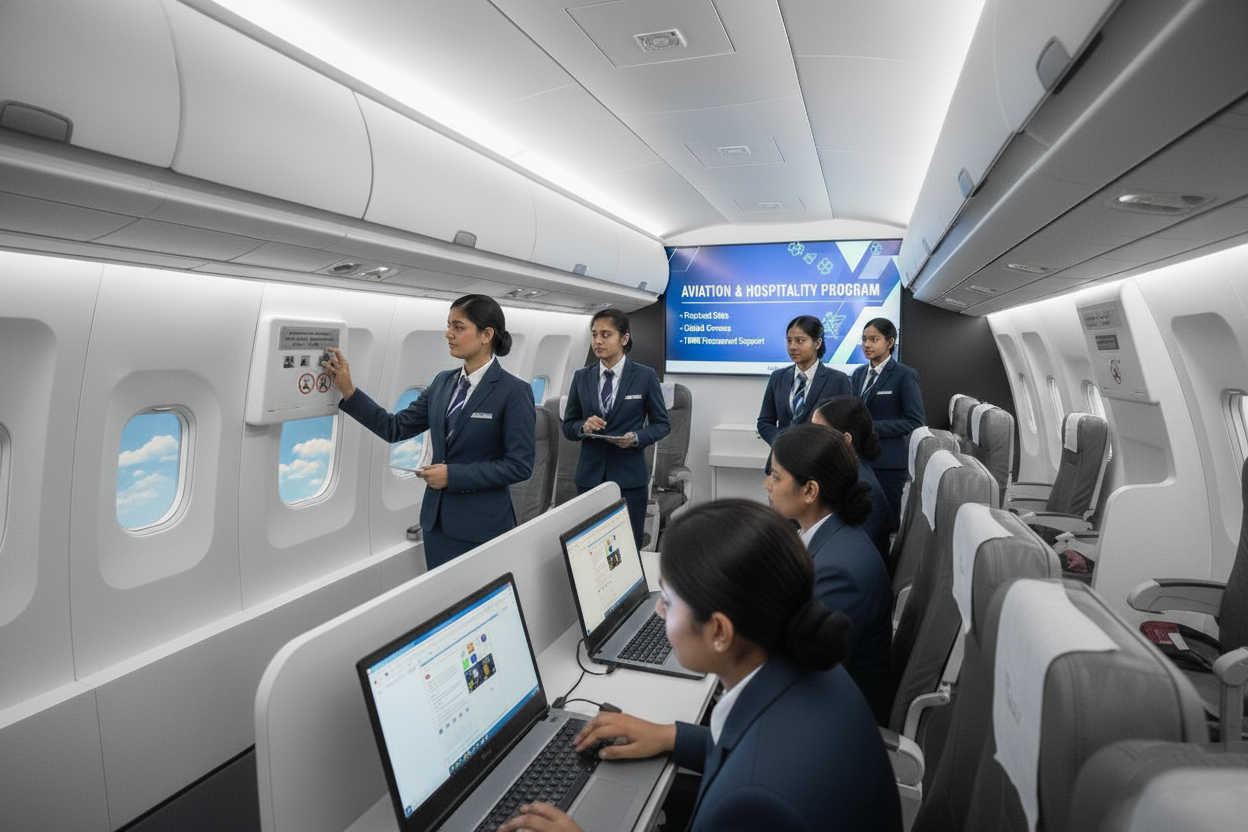
Any stream accepted. Combines business management fundamentals with aviation-specific training across 6 semesters. Built for a longer career, not just a first job.
Needs 12th with Physics and Maths, minimum age 17, and a DGCA Class 1 medical. The most expensive route by a wide margin.
Needs 12th Science. Technical coursework from year one. The only route that leads to hands-on aircraft systems work.
Match the track to your stream first. Picking the wrong track is what actually wastes a year, not picking the “wrong college.”
How Much Do Aviation Courses After 12th Cost?
Cost entirely depends on the track. There isn’t a single number that tells you how much an ‘aviation course fee’ costs.
Diplomas cost less because they take less time to complete. While a degree takes 3 years and costs more overall, the fee is spread across six semesters, and you actually get a business degree in addition to aviation. The cost of training a pilot is the highest, because of the cost of flying hours and time in a simulator, which increases the overall cost. AME costs slightly less than training a pilot, mostly due to the lab and workshop fees.
Ask any institute for a full fee breakup in writing before you enrol. Tuition, exams, uniform, add-ons, all of it. A number given verbally during counselling is not a number to budget against.
What Eligibility Do You Need for Each Track of Aviation?
Eligibility rules stops options before fee and curriculum rules even come into play.
- Diploma and degree: 12th pass, any stream
- Pilot training: 12th with Physics and Maths, minimum age 17, DGCA Class 1 medical
- AME: 12th Science background
If your stream already rules out piloting or AME, your real decision is just diploma versus degree.
Diploma or Degree: Which One Actually You Need?
Most students don’t consider this choice and end up regretting it two years later when they’re stuck in an entry-level position and can’t advance.
A diploma gets you working fast, but, unfortunately, it caps at an entry-level position and you will probably have to pay for more education to move up the career ladder in the future. ISMT’s degree program balances the business side of aviation with training in accounting, HR, and marketing alongside the training in aviation which many airlines like to see in their employees for supervisory positions in the future.
| Factor | Cabin Crew / Ground Staff Diploma | 3-Year Aviation & Hospitality Degree |
|---|---|---|
| Duration | 3 to 12 months | 3 years, 6 semesters |
| Eligibility | 12th pass, any stream | 12th pass, any stream |
| First job timeline | Faster, within months | Longer, but broader entry roles |
| Business foundation | Typically not included | Accounting, HR, marketing, operations |
| Path to management | Needs further qualification later | Built into the same programme |
How Much Cabin Crew and Ground Staff Actually Earn?
Numbers on websites may vary greatly because most of them fail to mention which of the three (stipend, base pay, total package) they are referring to. Let’s look at actual 3rd party data from the latter half of 2026.
Cabin crew: Glassdoor’s cabin crew salary data for India puts the average around 70,000 rupees a year, with a typical range of roughly 26,000 to 2,90,000 rupees depending on experience, based on 690 salaries submitted as of the site’s latest update. Domestic freshers usually start at 25,000 to 50,000 a month once the training stipend converts to full pay. Gulf and international carriers pay a lot more, often tax-free, but want experience most freshers don’t have yet.
Ground staff: Glassdoor’s ground staff salary data for India shows a typical base pay range of 15,000 to 25,000 rupees a month, rising toward supervisory pay with experience and airline. Mumbai and metro listings run higher than smaller-city averages, though sample sizes vary by location.
These are indicative ranges, not guarantees. Pay depends on airline, city, and role. Confirm actual numbers with recruiters during placement season, not from a blog post.
Where Aviation will Take You?
Cabin crew is what most people picture first. It’s one of at least four real directions.
- Cabin crew: Junior crew to senior crew to purser to cabin service manager. Takes 5 to 8 years to reach senior. Irregular hours, time away from home.
- Ground staff: Check-in, boarding, baggage, customer service. Steadier hours, moves into supervisory and operations coordination over time.
- Airport hospitality and lounge services: Blends aviation with hospitality. Premium passenger services, in-flight catering coordination. Less frontline-intensive than cabin crew.
- Aviation management: The long game. Airport operations, commercial operations, training roles. Needs a few years of experience plus a business qualification.
A degree foundation generally fast tracks you into management faster than a diploma on its own.
What you can Do Right Now
- Match your 12th stream to one of the four tracks above. Rule out what your stream doesn’t allow.
- Shortlist between diploma and degree based on how fast you need a first paycheck versus how far you want the qualification to carry you.
- Check the Aviation and Hospitality programme page for the full curriculum and current seat availability, or the full course list if you’re still comparing tracks.
- Ready to move? Start with the admission form.
Written by Devesh Tatkare, SEO Executive at ISMT Business School.
Last Updated: September 08, 2026
Course names, structure, and fees mentioned here are subject to change. Confirm the exact programme name, current syllabus, and awarding body directly with the ISMT admissions office before applying or paying any fee.
Frequently Asked Questions
Cabin crew, ground staff, and the aviation and hospitality degree accept any stream. Only pilot training and AME need Science, and piloting specifically needs Physics and Maths.
A diploma is fastest, often a paycheck within months of finishing a 3 to 12 month course. A 3-year degree takes longer but opens a wider range of entry roles and a faster path up later.
Neither wins outright. Diploma gets you working sooner. A degree, like ISMT's 3-year programme, adds a business foundation that matters more once you're aiming for supervisory roles.
As of mid to late 2026, domestic cabin crew freshers commonly start at 25,000 to 50,000 rupees a month, ground staff at 15,000 to 25,000, per salary-aggregator data. These are indicative ranges, not guarantees, and vary by airline, city, and role.
No institute can honestly guarantee placement for every student. ISMT runs campus recruitment drives, gives aviation-specific interview prep, and keeps supporting you after graduation until you're placed. Confirm current placement numbers with admissions before applying.