
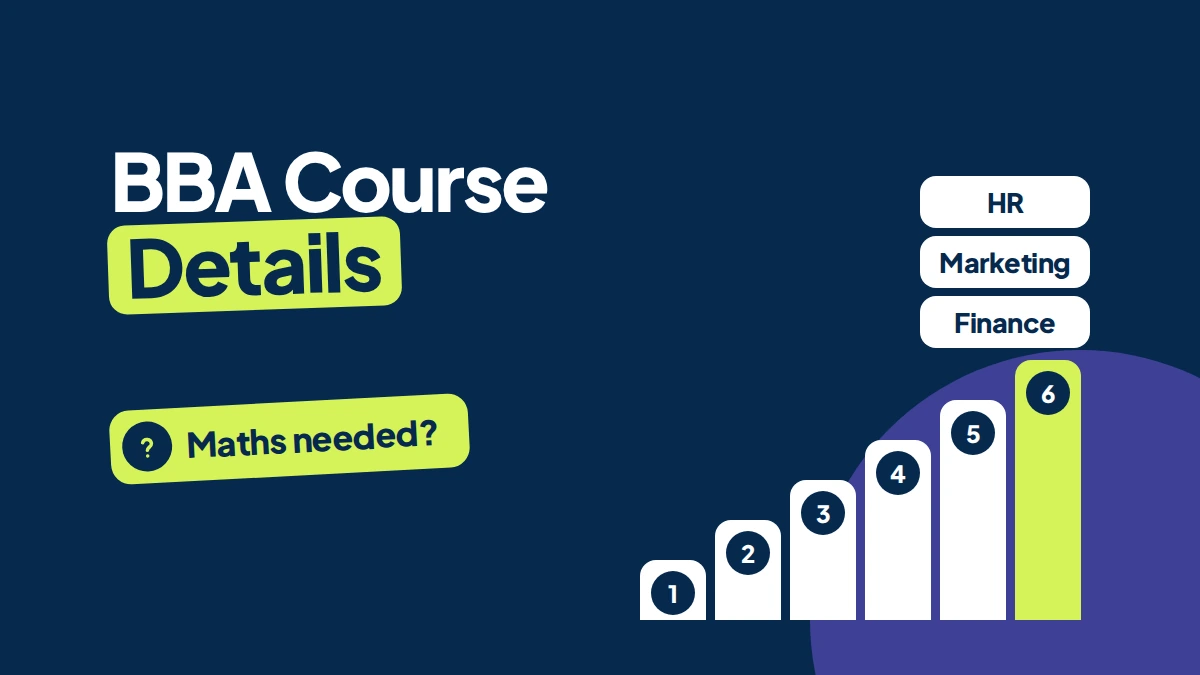
A BBA (Bachelor of Business Administration) is a 3-year, 6-semester undergraduate degree in
management. You can join after 12th in any stream, and each college sets its own minimum marks. In Maharashtra,
seats are filled either through the State CET Cell’s admission process or directly by the college.
What are the key BBA course details?
A BBA runs for three years and six semesters, and each college in Maharashtra chooses its own eligibility and
admission route.
| Full form | Bachelor of Business Administration |
|---|---|
| Duration | Usually 3 years (6 semesters) |
| Eligibility | 12th pass, minimum marks set by each college |
| Admission in Maharashtra | State CET and CAP, or direct admission |
| Core subjects | Management, accounting, marketing, HR, business law, economics, communication |
| Common specializations | Marketing, Finance, HR |
| Next step | A job, or an MBA or PGDM |
Who can apply for a BBA after 12th?
Students who have done Science, Commerce and Arts can all apply after 12th. Check the college prospectus to see
which colleges have their own minimum marks requirement and subject requirements. Some colleges require a 12th pass with any stream with a minimum of 50%, and name no compulsory subject.
In the below given example syllabus, Maths is not required at the time of admission, but Business Maths and Cost
and Management Accounting are offered in the third and fourth semesters. Eligibility and syllabus are different
questions and this is the part most students skip. You can expect some numbers even if you have not studied Maths
in the 12th.
Do you need an entrance exam for a BBA in Maharashtra?
It depends on the admission route. There are two.
- State CAP route. According to the State Common Entrance Test Cell,
Maharashtra, seats filled through the Centralised Admission Process need a score in the
MAH-BHMCT/BCA/BBA/BMS/BBM CET. For 2026-27, the exam ran from April 28 to 30, 2026, and BBA CAP registration
opened on July 6, 2026. - Direct admission route. Some institutes admit students directly, outside
CAP. This no CET route
skips the entrance exam, so confirm each college’s own rules and dates.
Ask which route a college uses before you pay any fee. CAP seats and direct seats follow different rules and
timelines. Dates change every cycle, so confirm the next schedule on the official CET Cell website.
What is BBA syllabus?
A BBA Syllabus generally builds general management skills for the first two years and specialization for the last
year. There isn’t much variability among colleges in the management, accounting, marketing, HR, law, economics and
communication courses offered. The table below gives a real example of six semesters.
Read the syllabus before you pay. Semesters V and VI show where the degree stops being general and starts
pointing at a job.
| Semester | Subjects |
|---|---|
| I | Principles of Management, Basics of Marketing I, Fundamentals of Accounting, Legal Aspects of Business I, Basics of Communication Skills (Presentation), Microsoft Office Tools (Practical) |
| II | Introduction to HRM, Basics of Marketing II, Financial Accounting, Legal Aspects of Business II, Business Communication I (Presentation), Advanced Excel for Data Analysis (Practical) |
| III | Business Maths, Disaster Management, Organizational Behaviour I, Financial Management, Marketing Management II, Presentation Skills, Information Technology |
| IV | Business Economics II, Organizational Behaviour II, Business Environment, Leadership Skills and Team Building, Production and Operations Management, Cost and Management Accounting, Basic Tally |
| V | MIS, Mercantile Law, Indian Economy, Research Methodology, Human Resource Management, Image Management |
| VI | Strategic Management, Entrepreneurship Development, Project, Yoga. Specialization subjects in HR (Industrial Relations and Labour Laws, Training and Development), Marketing (Consumer Behaviour, Advertising and Media Management) or Finance (Business Taxation and Auditing, Banking and Finance) |
Some colleges run focused versions as separate programmes, for example BBA in Accounts and Finance and BBA in Event Management. Each has its own curriculum.
Which BBA specialization should you choose?
Pick the one that matches the work you can picture yourself doing every day, not the one that sounds best. The
three options in that example are:
- Marketing: consumer behaviour, advertising and media. It suits students
who like brands and persuasion. - Finance: taxation, auditing and banking. It suits students who are
comfortable with numbers. - HR: labour laws, training and development. It suits students who like
people and process.
What else can be offered with the BBA program?
Better programmes include a Certificate or two. One particular programme includes a Certificate Program in
Business Leadership, an Advanced Excel Certification, a free online course on communication and interview skills,
life skills, and guest lectures by industry professionals. An international study tour to Singapore or Malaysia is
optional.
Some programmes provide students the option to pick any one of the value-added courses: Government Exam Training
(IBPS, Banking, SSC, Railways), MBA Entrance Training, Digital Marketing, Data Analysis, Certificate in Banking
and Finance/HR. Students have to request for the list of extras (along with what the fee covers) in writing.
What career opportunities and salary can I expect after a BBA in Mumbai?
After earning their BBA, students usually take entry-level positions in marketing, HR, finance or operations, and
pursue an MBA or PGDM later. Banks and NBFCs as well as FMCG and media and advertising companies, as well as IT
services and e-commerce companies, recruit BBA graduates.
Most of the course pages mention salaries without a source and a date. These are quoted from PayScale and cover
the year 2026. They are market figures for Mumbai and represent early-career base pay for the three
specializations and not placement results of any college.
| Role | Average a year | Range a year (10th to 90th percentile) |
|---|---|---|
| Marketing Executive | ₹3.64 lakh | ₹2.07 to ₹7.93 lakh |
| HR Administrator | ₹2.84 lakh | ₹1.79 to ₹6.79 lakh |
| Financial Analyst | ₹5.87 lakh | ₹2.42 lakh to about ₹10 lakh |
PayScale’s early-career band includes staff with some work experience, so a first job can pay less than these
averages. Build Excel skills, communication and internship experience early. Those are the parts of your profile a
recruiter can test.
Is a BBA worth it?
Yes, if you want to start a business career at 21 and plan to add an MBA or PGDM later. It is a weaker choice if
you want a technical career such as engineering or data science.
Compare it with other degrees before you decide. BBA vs other business
degrees shows how it stacks up, and MBA vs PGDM in Mumbai
explains what comes after.
Why you should study a BBA in Borivali, Mumbai?
When you study in a location near home, you have more time to spend on self-study and internships, as you won’t
be wasting time commuting to and from class. So, if you are in the areas of Borivali, Kandivali, Malad or Dahisar,
it
makes sense to study in Borivali West near the
Borivali metro station.
Certain colleges allow their students to take up part time jobs and/or internships and provide other facilities.
Make sure you check with the colleges about what they do to support students who do part time jobs/internships
before you assume it is supported.
What should you do next?
Four steps, in this order:
Step 1: Check eligibility. Each college sets its own
minimum marks and subject rules.
Step 2: Pick your route. CET and CAP, or direct admission.
Step 3: Get details in writing. Ask for the total 3-year
fee, the syllabus and the list of extras.
Step 4: Talk to a counsellor. Send an admission enquiry form to check eligibility and the route
for the college you like.