
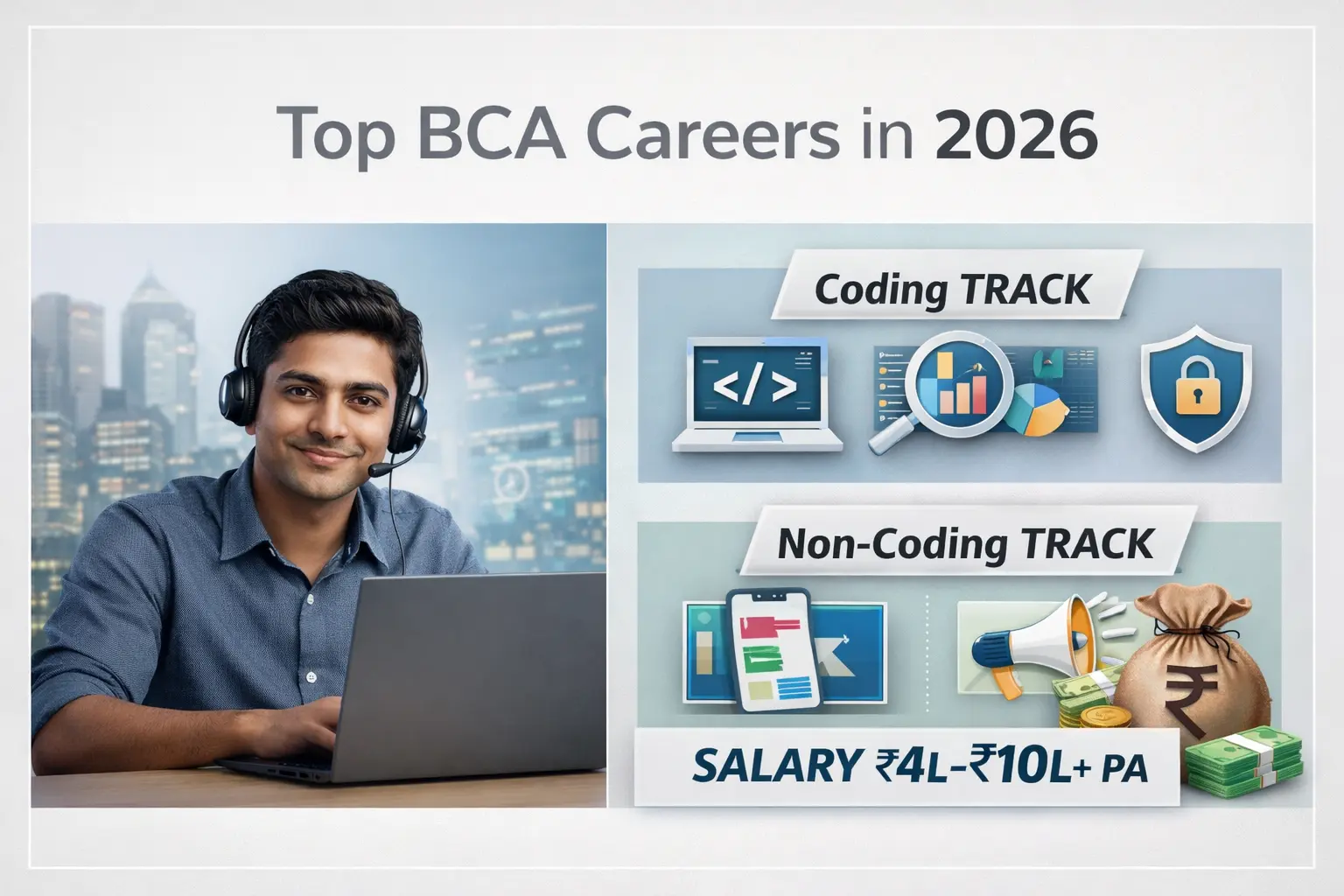
If you are here, you likely have one burning question: What exactly can I do after BCA in 2026, and how much will I earn? The market has already evolved. AI is everywhere, Remote work has shifted into the mainstream, and the industry values skill over degree.
Tip for those anxious about admissions. Missed entrance exams? Want to skip that stress? No worries. There are great BCA colleges in Mumbai that provide direct admissions.
You may not know this, but there are direct admission options to best colleges, and this a completely valid and immediate way to begin a BCA degree.
BCA graduates split into two real tracks in 2026: coding roles (full stack, data analyst, cybersecurity) and non-coding roles (UI/UX, product, technical SEO). Fresher pay at service companies runs Rs 3 to 6 lakh a year. Product companies and funded startups pay more, Rs 6 to 10 lakh, but only for candidates who show real, shipped work, not just a degree.
How do BCA fresher salaries break down per month?
The real number you will see in your bank account differs from what appears on annual statements. This is what three standard packages mean monthly, after normal deductions.
- Rs 3.5 LPA: about Rs 29,000 a month before tax, roughly Rs 24,000 to 25,000 in hand. This is the most common first offer, not the bottom of the range.
- Rs 5.0 LPA: about Rs 41,600 before tax, roughly Rs 35,000 to 36,000 in hand. This is what a decent portfolio buys you over the baseline offer.
- Rs 7.0 LPA: about Rs 58,300 before tax, roughly Rs 49,000 to 50,000 in hand. At fresher level, this usually means a product company, not a service company.
| Job Role | Entry-Level (LPA) | 3 to 5 Years (LPA) | What actually moves the pay |
|---|---|---|---|
| Software Developer | 3.5 – 6.5 | 10 – 18 | System design, cloud |
| Data Analyst | 3.5 – 6.0 | 8 – 14 | SQL plus Python plus one BI tool, not one alone |
| Web Developer | 3.0 – 5.5 | 8 – 14 | React or Next.js, not jQuery-era skills |
| QA / Tester | 3.0 – 5.0 | 7 – 12 | Automation (Selenium), manual testing alone caps you |
| System Admin | 3.0 – 4.5 | 6 – 9 | Linux and scripting, GUI-only skills do not scale |
What can you expect to do if you graduate from BCA in 2026?
Your first offer is not based on your CGPA. It is based on whether you picked and built something in a particular track. You have two options. Choose either before graduating, because after graduating a track is pointless.
Coding track
Right now Full Stack Developer would be your safest bet. Companies prefer to hire one developer rather than two juniors that can cover both the front end and back end. As a fresher, your pay will be between 3.5 to 6.5 lakh, although it can go higher if you have two or three real projects on GitHub.
Data Analyst is also a reliable entry point. The amount of people quoting (Rs 5 to 10 lakh) is a rare case, and most people make Rs 3.5 to 6 lakh. The salary increase to 7 to 8 lakh comes after you have all three of SQL, Python and one BI tool.
Cybersecurity Analyst Pay ranges between Rs 4 to 9 lakh, but nothing is really hired at this position with a degree. CEH certification is really needed to get into this field, without spending at least this amount, this field isn’t for you.
Non-coding track
A UI/UX Designer role exists, and it pays between 4 and 7 lakh as a fresher. This is a combination of psychology and visual arts. The most important part of this role is a website portfolio containing 3 to 4 studies. Recruiters typically don’t look at applications without this.
Out of all the positions mentioned, Junior Technical Product Manager is by far the most difficult and pays between 6 to 12 lakh. This is because almost no one gets hired here without doing a product-related internship. Don’t try for this role unless you have an internship.
The position for Technical SEO and Digital Marketing is the most underrated of all the positions. The initial salary for this falls between 3 to 6.5 lakhs, but with a BCA degree you have an advantage over other marketing graduates that can’t even identify a site’s technical issues. So don’t take this job as a backup, it’s a legitimate first job.
Does the city you work in actually change your salary that much?
Yes, by 20% to 30% between a metro and a tier-2 city, but rent eats most of that gap, so it is a weaker deciding factor than most guides suggest.
- Bengaluru has the most openings for full stack and data roles, starting pay 4.5 to 6 LPA. It is also the most expensive city on this list to actually live in.
- Pune runs steadier hiring through large service companies, starting pay 3.5 to 5 LPA, lower cost of living than Bengaluru.
- Hyderabad has large global tech offices, starting pay 4 to 6 LPA, and infrastructure that has kept pace with hiring growth better than most metros.
- NCR mixes product and service hiring, starting pay 3.5 to 5.5 LPA, more volatile than the other three on job security.
- Remote-first startups often pay metro-level cash while you live in a tier-2 or tier-3 city. This is where a tier-3 city fresher actually beats a metro fresher on real disposable income.
How to get hired with zero work experience?
Your degree gets your resume chosen and gets you to the first round interview, but it doesn’t get you the job offer.
Build something that is not a library management system
Recruiters have seen a thousand library management systems and a thousand student databases.They lose interest and start to skip over applications as soon as they identify a system that they have seen before. Build a solution to a problem you encountered and publish it along with the decisions you made and the reasoning behind those decisions in the README file and not just the features. A list of creative project ideas that go beyond the usual academic submissions is at the end of this document.
An unpaid internship can beat a high CGPA
A three month internship where you shipped real code, even unpaid, reads stronger on a resume than a 9.0 CGPA with zero practical work. Cold-messaging founders of small startups on LinkedIn and offering a short trial period is not a desperate move, it is how a large share of BCA graduates get their first real reference.
Certifications are just filters, they do not replace a weak portfolio
Google Data Analytics, AWS Cloud Practitioner, and Meta Front-End Developer are the three that recruiters actually recognise in 2026. A certificate with no project to back it up gets you past an applicant tracking system and nowhere past the interview.
MCA or a job straight after BCA, which one actually makes sense?
The honest answer is that an MCA is optional for most roles now, not a downgrade to skip it, and not automatically the smarter move either. It depends on what you are missing.
MCA is worth it if
- You are targeting product companies at the top of the pyramid who still require a master’s degree for entry level.
- Your programming fundamentals need serious strengthening, and you would benefit from structured learning, guided practice, and hands-on projects over two years.
- You want to go deep into AI, ML, or data science research, not just use these tools, actually build them.
Take the job instead if
- You already have an offer, even at Rs 3 to 4 lakh. Real experience compounds faster than a second degree at this stage, and a bad first year at a weak company is still worth more than no experience at all.
- You are aiming for design, marketing, or web development, fields where your portfolio outweighs any postgraduate degree.
- You need the income now. An online MCA while working is a real, common path, not a compromise.
What does the first year on the job actually feel like?
Job placement brochures don’t cover this.
- Month 1 to 3: You will feel like you’re falling behind. An actual codebase with decades of decisions will not look like anything you’ve done for a college assignment. Do not worry – it is not because you chose the wrong career field.
- Month 4 to 6: you start shipping features of the product that will start to give you some value, and the panic from month one will go away.
- Month 7 to 12: you will be trusted enough to work on a small feature and not have someone checking your work along the way.
- Year 2: this is when a 30% to 50% hike or a strategic switch actually becomes realistic, not before.
What is actually changing in BCA hiring right now?
- AI coding tools stopped being optional. Juniors who use Claude well ship faster and get noticed faster. Juniors who refuse to touch it are falling behind their own batch, not some abstract future workforce.
- A shipped app beats a second degree at the fresher hiring stage. Recruiters have started checking GitHub before they check which college you attended.
- Remote hiring for freshers is no longer rare. Startups in Bengaluru and Pune are hiring remote interns who never set foot in the office, so relocation is a choice now, not a requirement.
Still finalising your BCA admission and want to skip the Common Entrance Test entirely? See the BCA colleges in Mumbai without entrance exam guide. For project ideas that actually make a recruiter stop scrolling, see the 30 best BCA final year project ideas guide.
Written by Devesh Tatkare | Last updated August 24, 2026.
Salary figures are indicative 2026 estimates compiled from multiple industry sources, including Glassdoor and AmbitionBox, and shift by role, city, and company type. Verify current figures before negotiating an offer.
Frequently asked questions
Yes. The Indian IT sector is growing, and the demand for skilled graduates who can manage and build tech is at an all-time high. The career scope in BCA includes roles in development, data science, cloud computing, and even non-coding tracks like product management.
Rarely, but not never. You need strong data structures and algorithms fundamentals (DSA) and a portfolio that proves problem-solving, LeetCode rank or personal projects, not textbook knowledge. Google does hire BCA graduates who clear that bar, but the bar is real and most freshers underestimate it.
Tech is huge. You can opt for high-paying roles like UI/UX Design, Product Management, or Technical Writing which require minimal coding. Many BCA career options India offers don't require you to write code daily.
No. While an MCA can help with initial starting salary in some MNCs, after 2-3 years of experience, your skills define your pay, not your degree. A BCA graduate with strong skills can earn the same or more than an MCA graduate.
Top-tier freshers (top 1%) with full-stack skills can crack offers of ₹12-15 LPA at funded startups. The average BCA fresher salary remains ₹3.5-5 LPA, but exceptional candidates with strong portfolios regularly exceed this range
Initially, B.Tech graduates from top colleges might start ₹1-2 LPA higher. However, by year 2-3, if you have built strong skills and switched companies strategically, the gap disappears completely. Your portfolio matters more than your degree.