
Table of Contents
Top BCA Project Pick for 2026: Evaluators currently favor Library Management Systems and Personal Expense Trackers because they demonstrate full-stack skills (Frontend + Database) without high risk of failure.
 Expert Insight
Many students panic and choose overly ambitious projects, then struggle to complete them. This list focuses on the sweet spot—projects that are realistic to build in one semester while still scoring high marks.
15 BCA Final Year Projects That Score High Marks
These projects are proven winners—not too simple, not impossibly complex.
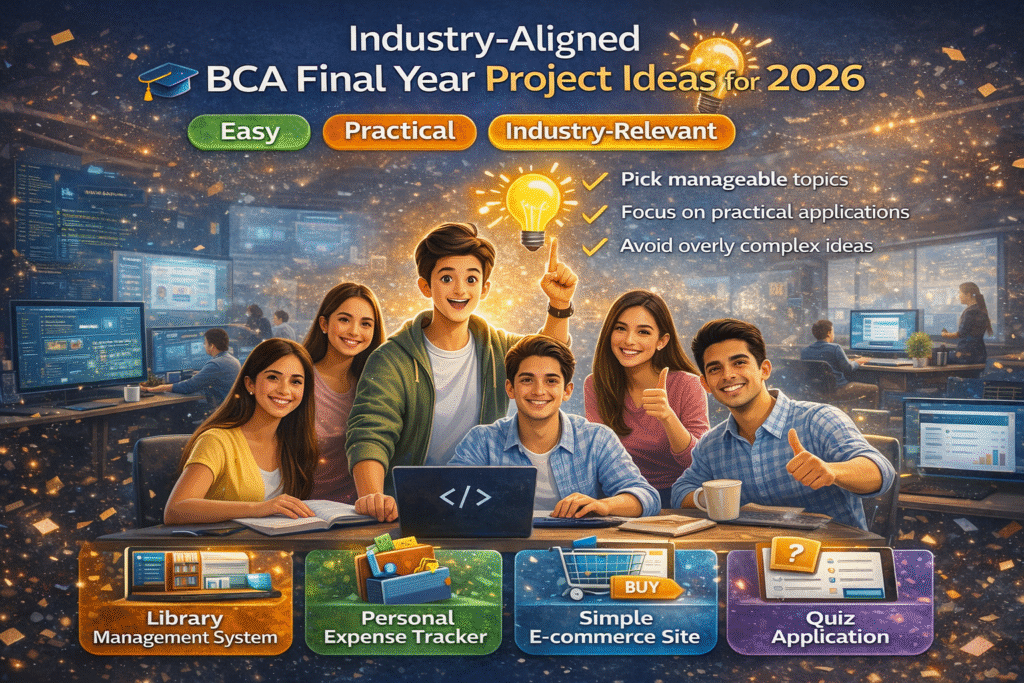
1. Library Management System
Manage book inventory, member records, issue/return tracking. Classic project that demonstrates CRUD operations effectively.
2. Student Attendance System
Track daily attendance, generate reports, send notifications. Simple but useful. Can be web-based or desktop.
3. Online Examination System
Create tests, set timers, auto-grade MCQs. Demonstrates session management and database handling.
4. Personal Expense Tracker
Log daily expenses, categorize spending, view monthly charts. Practical project everyone can relate to.
5. Simple E-commerce Website
Product catalog, cart, basic checkout. Simulate payment. Shows full-stack web development skills.
6. Employee Management
Add employees, track attendance, calculate salary. Good for business logic and reporting.
7. College Notice Board App
Admin posts notices, students view by category. Simple functional search/filter.
8. Basic Billing System
Create bills, add items, calculate tax. Perfect for small shops.
9. Blood Bank Management
Register donors, track blood types, match requests. Solves a real problem.
10. Quiz Application
Scoring system, leaderboard, difficulty levels. Fun to build and demo.
11. Hostel Management
Room allocation, visitor records, mess menu. Relatable scope.
12. Simple Inventory Management
Track stock, low inventory alerts. Basic stock management.
13. Online Appointment Booking
Book slots with doctors/teachers. Basic scheduling logic.
14. Resume Builder App
Enter details, choose template, generate PDF. Clear functionality.
15. Student Result Management
Enter marks, calculate grades, view semester results.
Web-Based BCA Project Ideas
These web projects are realistic for students with basic HTML, CSS, JavaScript, and backend knowledge:
16. Event Registration Portal
Register for events, view details, download e-tickets. Simple flow without complex logistics.
17. Online Notepad/Todo
Create notes, organize tasks, set reminders. Add user auth for personal accounts.
18. Simple Blog Platform
Write posts, add images, comments. Demonstrates basic CMS concepts.
19. Recipe Manager
Save recipes, search by ingredients. Fun project with practical utility.
20. Social Media Clone (Basic)
Create user profiles, post text/images, follow system. Focus on core user interaction.
21. Simple Chat Application
Real-time messaging between users. Demonstrates socket programming basics or persistent connection logic.
Desktop Application Projects
Best for Java, Python, or C# based projects, demonstrating local file/database management:
22. Pharmacy Management
Medicine inventory, expiry alerts, patient records, billing. Good for understanding local transactional database systems.
23. Bus Pass Management
Issue bus passes, track validity, generate ID cards with QR codes. Focus on secure data storage and report generation.
24. Voting System (Offline)
Cast votes, securely count results, display simple statistics. Keep the scope local (e.g., for a class election) to avoid complex network security.
25. Banking Management (Basic)
Create accounts, deposit/withdraw, check balance. Simulate banking logic—do not use real financial connections. Demonstrates transaction logging.
26. Music Player App
Play audio files, create and manage playlists. Good for learning file handling, multimedia libraries, and clean UI design.
Small-Scale AI/ML Projects
Note: These projects demonstrate basics. Don’t pick these unless you are comfortable with basic Python/ML libraries.
Expert Insight
27. Spam Email Classifier
Classify emails using simple machine learning algorithms (like Naive Bayes or Logistic Regression). Use existing datasets.
28. Basic Movie Recommendation
Recommend movies based on genre or simple content filtering. Avoid complex collaborative filtering for a BCA project.
29. Handwritten Digit Recognition
Recognize digits 0-9 from images using the MNIST dataset and basic neural networks or classification models.
30. Sentiment Analysis Tool
Analyze text (e.g., from reviews) to determine if the tone is positive, negative, or neutral. Use pre-trained models or basic NLP libraries.
How to Choose Your Project
Match Your Skill
If you’ve never used ML, don’t pick AI. Stick to technologies you have practiced.
Consider Time
You have 2-3 months. Choose something completable while attending classes.
Understand Logic
You must defend this in viva. If you can’t explain the code, don’t build it.
Demo Capability
Can you demo it in 10 mins? Visual projects with clear inputs/outputs score better.
Conclusion
For BCA 3rd year students, the final year project doesn’t have to be stressful or overcomplicated. You’re not expected to build something huge or highly advanced. What really matters is choosing a project you can finish properly and explain with confidence.
The ideas in this list are meant to help you pick something practical and manageable—projects that clearly show your understanding of programming, databases, and basic problem-solving. A simple project that works well will always leave a better impression than a complex idea that’s incomplete.
So choose wisely, focus on understanding what you build, and keep your project realistic. If you can explain your work clearly and demo it smoothly, you’re already doing exactly what evaluators expect from a BCA 3rd year project.
ISMT Academic Desk
Expert guidance for management and technology careers.
Students who missed MAH-CET can still explore BCA colleges in Mumbai without entrance exams.
Need Career Guidance?
Contact ISMT Business School for program details.
 9930526101 / 8976055540