
Is interior design actually a good career option in India right now?
Yes and the reasons are valid and should not be overlooked. Shifts in how much Indian households and businesses are willing to spend in having their spaces designed have a lot of reasons, like the growth in real estate and urban housing, and a crucial reason is that people are willing to spend on design. While several estimates put the market size at around $29 or $37 billion, almost all market reports agree that the market is also growing at over 8% each year, and this growth is not because of a fad that will disappear in a few years. While it is true that the field of interior design services is growing, the potential hiring companies will likely see growth much slower than the potential growth of the field as a whole. This is just something you have to keep in mind when considering this field. The size of the market isn’t everything.Does interior designing actually have scope in the future, or is it getting saturated?
It has real scope, but the easy, low-skill end of the market is getting more crowded. Basic residential decoration work now competes with online platforms and semi-trained freelancers offering cheap services. Where genuine scope remains strong is in commercial interior design (offices, retail, hospitality, healthcare spaces), sustainable and smart-space design, and specialised roles like 3D visualisation, where trained skill still clearly outperforms someone who picked up a few tricks from YouTube. If you are going in with a real qualification and a plan to specialise, rather than expecting to freelance casually on residential jobs, the future here is genuinely solid.Can you study interior design after 12th Commerce or Arts, or do you need Science or NATA?
YStudying interior design is possible after 12th arts or commerce. This is a very common area of confusion; it is best to be clear, many people assume NATA is an exam for interior design, but it is simply an architecture entrance exam. Most reputable interior design diploma and degree courses in India (including the B.Voc and B.Sc routes) accept students who have cleared 12th, irrespective of the stream, science, commerce, arts, and no additional design entrance exam is required at most of these institutes. Always check with the institute, a few selective/higher end design institutes may conduct their own entrance exams, but stream restrictions are not seen here.What is the real difference between a diploma and a full degree in interior design?
A diploma is shorter, usually 6 months to a year, costs less, and covers the basics: fundamental space planning and one or two design software tools. It gets you working faster, often in a junior or assistant role. A full degree takes longer, from three years to complete a B.Voc, B.Sc, or B.Des. You’ll learn to use and understand the selection of building materials, lighting, and the structure and the safety considerations of design. Lastly, you will learn how to deal with clients and run a business. Most full degree programs include a long internship or a big design project. A diploma can get you into the field sooner. A degree tends to open more senior, better-paying roles later, and matters more if you eventually want to run your own studio or move into project leadership rather than stay a junior visualiser indefinitely.Is a B.Voc in Interior Design a real graduation degree, or something lesser?
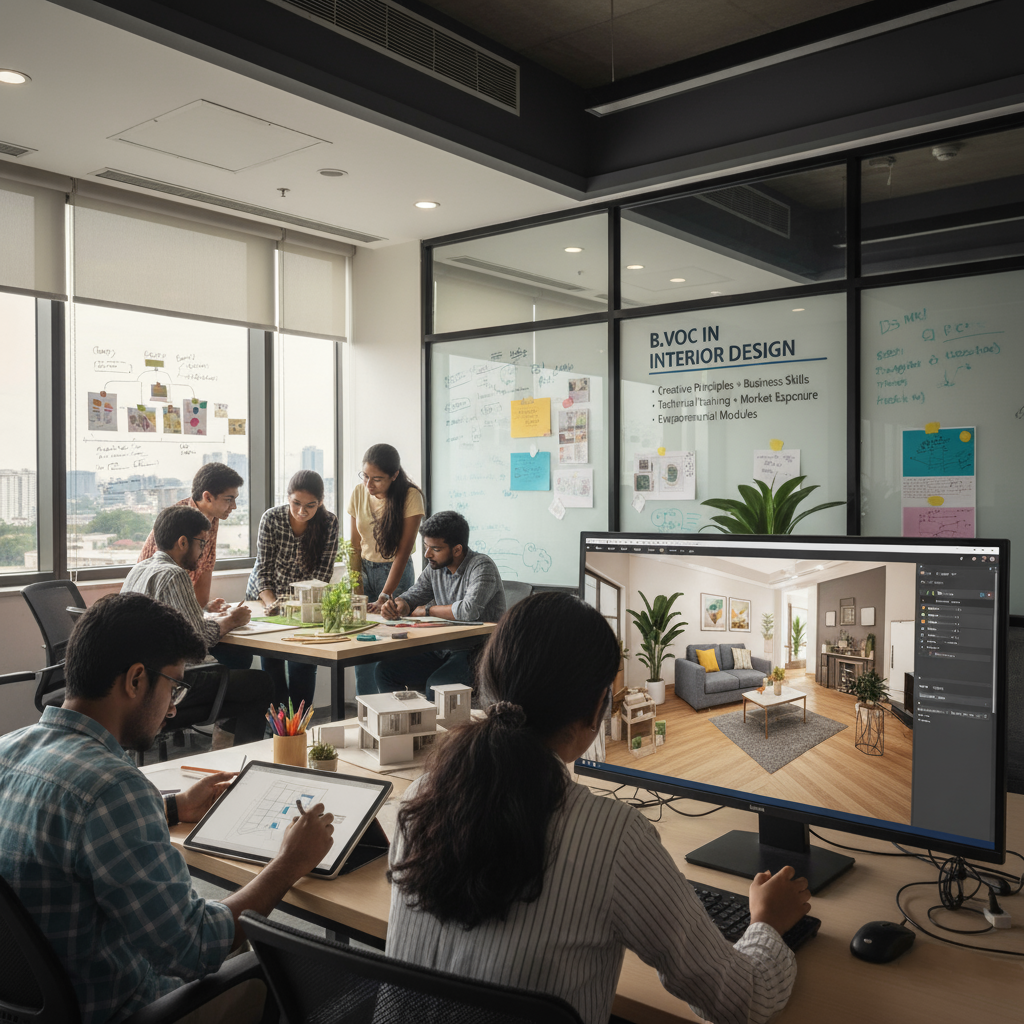
It is a real degree. B.Voc, Bachelor of Vocation, is recognised by the University Grants Commission and is treated as equivalent to a conventional bachelor’s degree like a BA, BSc, or BCom. A UGC circular specifically extended this equivalence to competitive government exams conducted by bodies like UPSC, SSC, and state public service commissions, so a B.Voc graduate is eligible wherever the requirement is simply “a bachelor’s degree in any discipline,” the same as any other UG degree holder. It also qualifies you to apply for postgraduate study, including an MBA, at most universities.
The one thing worth checking directly with any institute offering a B.Voc: confirm which university or body is actually granting the degree and that it carries current UGC recognition, since recognition status can vary by the specific awarding institution, not just the degree name.What software skills does interior design actually require?
Across the industry in India, AutoCAD, SketchUp, and 3D rendering tools like V-Ray or Lumion are consistently the baseline expected skills, with Revit increasingly asked for at firms doing larger commercial or architectural-adjacent work. How deeply any specific program teaches these tools varies a lot between institutes, some go hands-on from week one, others treat software as a lighter add-on to design theory. Ask any institute you are considering exactly how many hours are spent on live software training versus lectures, and ask to see actual student project files, not just a syllabus list, before you judge how seriously they teach it.What does an interior designer actually earn as a fresher in India?
Most current sources converge on a fresher range of roughly Rs 2 lakh to Rs 4.5 lakh a year, or about Rs 20,000 to 30,000 a month, for junior designer, design assistant, or 3D visualiser roles. That climbs meaningfully with experience: designers with several years behind them and a strong portfolio commonly reach Rs 6 lakh to Rs 10 lakh, and senior specialists or independent studio owners can go well beyond that, though freelance and studio income is naturally less predictable than a salaried role.| Career stage | Typical range | Notes |
|---|---|---|
| Fresher (0-2 years) | Rs 2 – 4.5 lakh/year | Junior designer, design assistant, 3D visualiser roles |
| Mid-level (3-6 years) | Rs 6 – 10 lakh/year | Depends heavily on portfolio strength and specialisation |
| Senior / specialist | Rs 10 lakh+/year | Commercial design specialists and senior consultants trend higher than residential-only |
| Freelance / studio owner | Variable | Higher ceiling, less predictable, depends on client base and reputation |
Which cities and specialisations actually pay better?
Commercial interior design, offices, retail, hospitality, healthcare, generally pays more than pure residential work, because project budgets and complexity are higher. Tier-1 cities with strong real estate and hospitality sectors offer both more volume of work and higher-paying clients, though cost of living eats into some of that gap the same way it does in most fields. Specialising early, rather than staying a generalist, tends to move your income faster than simply accumulating years of broad experience.Yes. India's interior design industry is growing at over 8 percent a year, driven by real estate, urbanisation, and rising spending on homes and commercial spaces. That is structural demand tied to the economy, not a short-term trend.
Most interior design diploma and degree programs in India accept students from any stream, Science, Commerce, or Arts. NATA is specifically for architecture, not interior design, so you generally do not need it unless a particular program explicitly asks for it.
Yes. B.Voc is a UGC-recognised bachelor's degree, equivalent to a BA, BSc, or BCom. It qualifies you for government exams that require a bachelor's degree and for further study such as an MBA, the same as any conventional degree would.
A diploma is faster and cheaper but covers less ground, usually the basics of space planning and one or two design tools. A 3-year degree goes deeper into materials, structural and lighting knowledge, business and client-facing skills, and usually includes a longer internship. The diploma gets you working sooner, the degree generally opens more senior and higher-paying roles later.
Most current sources put fresher interior design salaries in India between roughly Rs 2 lakh and Rs 4.5 lakh a year, or about Rs 20,000 to 30,000 a month. Pay rises meaningfully with a few years of experience and a strong portfolio, and specialists in commercial design tend to earn more than residential-only designers.